




Sri Eshwar Engineering College

ELECTRONICS ENGINEERING
(VLSI Design and Technology)

0 LPA

HIGHEST SALARY PACKAGE

0 +

RECRUITERS
0 +

PUBLICATIONS
0 +

PATENTS

25LPA

HIGHEST SALARY PACKAGE

120+

RECRUITERS

450+

PUBLICATIONS

40+

PATENTS

PROGRAMME SCOPE

Driven by the Indian Semiconductor Mission (ISM), this program prepares the students for India’s booming Semiconductor chip ecosystem. The students will master semiconductor devices, CMOS design, FPGA implementation, ASIC development, and CAD tools. The curriculum bridges the gap between theory and industry by providing deep learning in fabrication, testing, and verification methodologies. As the ISM fuels massive domestic growth in chip manufacturing and design, graduates are uniquely positioned for high-paying placement opportunities. The students will be fully equipped to secure elite roles in Digital, Analog and Testing Domains in Semiconductor Industry..

LEARNING SCOPE

The B.E. (VLSI Design and Technology) programme at Sri Eshwar is driven by a team of highly qualified faculty blending strong technical expertise with industry experience. Students receive comprehensive education in core areas such as Semiconductor Devices, Network Analysis, Digital Electronics, Analog Electronics, Integrated Circuits, VLSI Design, and various Professional Electives in Semiconductor Chip design. The curriculum is enriched with exposure to advanced domains like Artificial Intelligence, Machine Learning, and modern EDA tools, ensuring alignment with current industry practices. This holistic approach equips graduates with both hardware and software skills, preparing them for careers in semiconductor design, chip fabrication, and emerging technologies.

CAREER PROGRESSION

With the Central Government’s “Make in India” policy, the Electronics manufacturing industry is poised to have exponential growth in India in the next decade and the ECE students and in particular VLSI students will have abundant opportunities to contribute to that growth. The field of Semiconductor chip design and fabrication is emerging as one of the most prominent fields of engineering studies with substantial demand for VLSI engineers all over the world. Upon acquiring the core competencies in VLSI Design and its latest EDA tools, the students will be able to start their career as RTL Design Engineers, Design and Verification Engineers, DFT Engineers, STA Engineers, Analog IC Design Engineers, Physical Design Engineers, Analog Layout Engineers and Post Silicon Validation Engineers.

VISION

To groom students into futuristic and globally competent VLSI Design and Technology engineering professionals.

MISSION

To impart quality education in VLSI Design and Technology with strong moral and ethical values, nurturing competent engineers, innovators, and future leaders.

To establish state-of-the-art infrastructure and provide opportunities to master emerging tools, technologies, and advanced EDA platforms.

To empower faculty towards excellence in teaching–learning, consultancy, research, and development in semiconductor and VLSI domains.

To foster industry-oriented and socially relevant innovations among students, driving.

PROGRAMME DETAILS

  • PEO1: Graduates will develop strong foundations in VLSI design, semiconductor technology, and embedded systems, applying their knowledge to create innovative, efficient, and industry-relevant electronic solutions.
  • PEO2: Graduates will continuously enhance their skills in emerging domains such as AI, Machine Learning, and advanced EDA tools in Semiconductor domain, ensuring adaptability to evolving technologies and global industry demands.
  • PEO3: Graduates will demonstrate leadership, teamwork, and entrepreneurial abilities while upholding professional ethics, contributing to sustainable and socially relevant advancements in electronics and VLSI technology.
  • PO1: Engineering Knowledge: Apply knowledge of mathematics, natural science, computing, engineering fundamentals and an engineering specialization to develop the solution of complex engineering problems.
  • PO2: Problem Analysis: Identify, formulate, review research literature and analyze complex engineering problems reaching substantiated conclusions with consideration for sustainable development.
  • PO3: Design/Development of Solutions: Design creative solutions for complex engineering problems and design/develop systems/components/processes to meet identified needs with consideration for public health and safety, whole-life cost, net zero carbon, culture, society, and environment as required.
  • PO4: Conduct Investigations of Complex Problems: Conduct investigations of complex engineering problems using research-based knowledge including design of experiments, modelling, analysis & interpretation of data to provide valid conclusions.
  • PO5: Engineering Tool Usage: Create, select and apply appropriate techniques, resources and modern engineering & IT tools, including prediction and modelling recognizing their limitations to solve complex engineering problems.
  • PO6: The Engineer and The World: Analyze and evaluate societal and environmental aspects while solving complex engineering problems for its impact on sustainability with reference to economy, health, safety, legal framework, culture, and environment.
  • PO7: Ethics: Apply ethical principles and commit to professional ethics, human values, diversity and inclusion; adhere to national & international laws.
  • PO8: Individual and Collaborative Teamwork: Function effectively as an individual, and as a member or leader in diverse/multi-disciplinary teams.
  • PO9: Communication: Communicate effectively and inclusively within the engineering community and society at large, such as being able to comprehend and write effective reports and design documentation, make effective presentations considering cultural, language, and learning differences.
  • PO10: Project Management and Finance: Apply knowledge and understanding of engineering management principles and economic decision-making and apply these to one’s own work, as a member and leader in a team, and to manage projects and in multidisciplinary environments.
  • PO11: Life-Long Learning: Recognize the need for, and have the preparation and ability for i) independent and life-long learning ii) adaptability to new and emerging technologies and iii) critical thinking in the broadest context of technological change.
  • PSO1: Ability to apply advanced concepts of analog/digital CMOS design, ASIC/FPGA design flows, and hardware description languages (Verilog/SystemVerilog) to design, simulate, and verify integrated circuits using industry-standard EDA and CAD tools.
  • PSO2:Understanding of semiconductor fabrication processes, testing methodologies, and packaging technologies.
  • PEO1: Graduates will develop strong foundations in VLSI design, semiconductor technology, and embedded systems, applying their knowledge to create innovative, efficient, and industry-relevant electronic solutions.
  • PEO2: Graduates will continuously enhance their skills in emerging domains such as AI, Machine Learning, and advanced EDA tools in Semiconductor domain, ensuring adaptability to evolving technologies and global industry demands.
  • PEO3: Graduates will demonstrate leadership, teamwork, and entrepreneurial abilities while upholding professional ethics, contributing to sustainable and socially relevant advancements in electronics and VLSI technology.
  • PO1: Engineering Knowledge: Apply knowledge of mathematics, natural science, computing, engineering fundamentals and an engineering specialization to develop the solution of complex engineering problems.
  • PO2: Problem Analysis: Identify, formulate, review research literature and analyze complex engineering problems reaching substantiated conclusions with consideration for sustainable development.
  • PO3: Design/Development of Solutions: Design creative solutions for complex engineering problems and design/develop systems/components/processes to meet identified needs with consideration for public health and safety, whole-life cost, net zero carbon, culture, society, and environment as required.
  • PO4: Conduct Investigations of Complex Problems: Conduct investigations of complex engineering problems using research-based knowledge including design of experiments, modelling, analysis & interpretation of data to provide valid conclusions.
  • PO5: Engineering Tool Usage: Create, select and apply appropriate techniques, resources and modern engineering & IT tools, including prediction and modelling recognizing their limitations to solve complex engineering problems.
  • PO6: The Engineer and The World: Analyze and evaluate societal and environmental aspects while solving complex engineering problems for its impact on sustainability with reference to economy, health, safety, legal framework, culture, and environment.
  • PO7: Ethics: Apply ethical principles and commit to professional ethics, human values, diversity and inclusion; adhere to national & international laws.
  • PO8: Individual and Collaborative Teamwork: Function effectively as an individual, and as a member or leader in diverse/multi-disciplinary teams.
  • PO9: Communication: Communicate effectively and inclusively within the engineering community and society at large, such as being able to comprehend and write effective reports and design documentation, make effective presentations considering cultural, language, and learning differences.
  • PO10: Project Management and Finance: Apply knowledge and understanding of engineering management principles and economic decision-making and apply these to one’s own work, as a member and leader in a team, and to manage projects and in multidisciplinary environments.
  • PO11: Life-Long Learning: Recognize the need for, and have the preparation and ability for i) independent and life-long learning ii) adaptability to new and emerging technologies and iii) critical thinking in the broadest context of technological change.
  • PSO1: Ability to apply advanced concepts of analog/digital CMOS design, ASIC/FPGA design flows, and hardware description languages (Verilog/SystemVerilog) to design, simulate, and verify integrated circuits using industry-standard EDA and CAD tools.
  • PSO2:Understanding of semiconductor fabrication processes, testing methodologies, and packaging technologies.


Corporate ADVISORY BOARD

Naming a few of our advisories working in top companies, who help us align our courses and curriculum to what the industry needs. Through ongoing knowledge sharing, guidance and expert advice, they play an important role in shaping our students to become industry-ready professionals.

Dr.T.Anbalagan

System PR Robert Bosch India (P) Ltd

Mr.A.Kandeepan

Sicrest Semiconductors Ltd.

Mr. R.Vigneshwaran

Sr.Manager- Software, VVDN Technologies

Mr.N.Venkatesh

Senior Director – Engg

ENHANCED LEARNING

LABS

  • Programming Languages Laboratory
  • Electron Devices Laboratory
  • Digital System Design & FPGA Laboratory
  • Analog Electronic Circuits and IC design Laboratory
  • Low power VLSI design Laboratory
  • Digital Signal Processing Laboratory
  • Communication Systems Laboratory
  • VLSI Design Laboratory
  • Testing of VLSI circuits Laboratory

VALUE ADDED COURSES

  • Functional Electronics and PCB Prototyping
  • RTL Design using Verilog
  • Design Verification using System Verilog & UVM
  • ASIC Physical Design
  • Analog Layout Design
  • Design for Testability

INNOVATIVE TEACHING

  • Experiential Learning through tools and simulations
  • Hands-on learning through Digital prototyping using TinkerCAD
  • Think-pair-share
  • Collaborative Learning through the Jigsaw Method
  • Problem-Based Learning (PBL) with GATE Questions
  • Interactive Code Debugging with GDB Compiler
  • Concept understanding using role plays
  • Real life examples/case studies

Head of the department

Professor & Head of the Department

FACULTY MEMBERS

Professor

Associate Professor

Assistant Professor

Assistant Professor

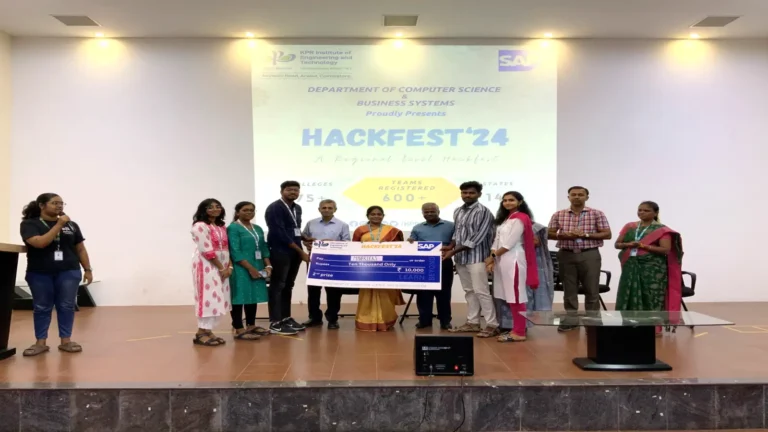
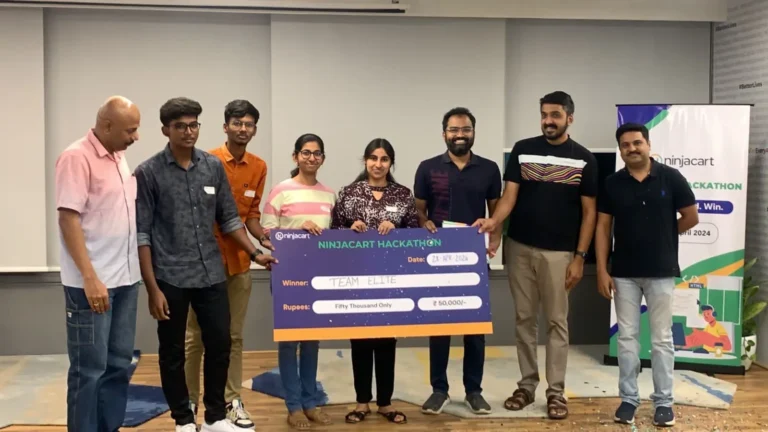
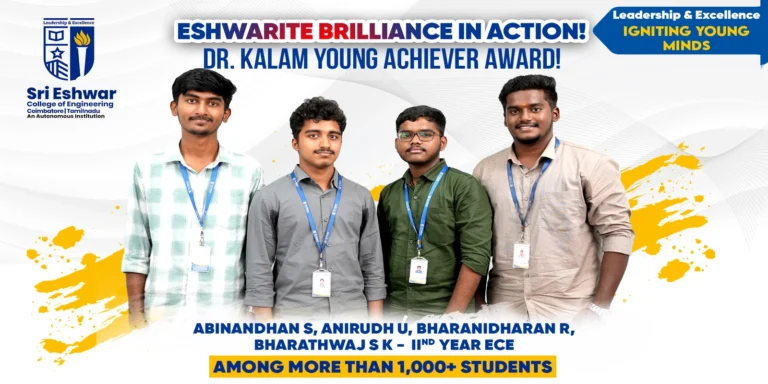
STUDENTS ACHIEVEMENTS

STAY TUNED FOR EVERYDAY HAPPENINGS

RESEARCH

Research work is a big part of every department at Sri Eshwar. Here’s the roundup of the research work – publications, patents, grants, seed funds, consultancy projects and the scholars/supervisors for the department

AU APPROVED
RESEARCH
supervisors


research
facilities


Publications


patents

research
grants &
seed funds


consultancy projects

INDUSTRY COLLABORATION

Each department has connections with relevant industry professionals, tie-ups through MOUs with companies in order to facilitate Internships, Industry visits, Projects, Knowledge Sharing Expert Sessions by industry experts. This greatly helps us bring in the industry-perspective into the courses being taught and a hands-on learning for the students.


mous

industry
visits


internships


coe
activities


projects

RECRUITERS

ALUMNI TESTIMONIALS

EE (VLSI) DEPARTMENT OFFICE

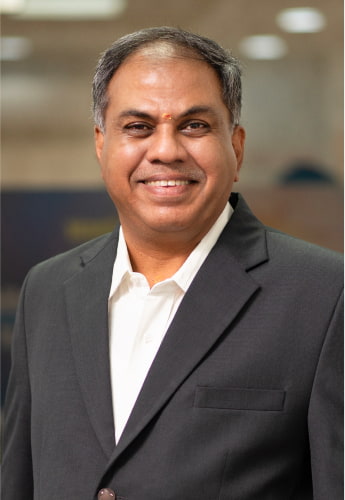
Dr.N.Shanmugasundaram
Professor & Head, EE (VLSI)
 +914259200350
Email: hodece@sece.ac.in

Ms.S.Priyadharshini
Dept. Office Secretary, EE (VLSI)
 +914259200341
Email: ece_support@sece.ac.in

Dr.K.N.Vijeyakumar

M.E., Ph.D.

Areas of Specialization

Analog and Mixed Signal IC design, Low power VLSI architectures for signal and image processing.

Vijeyakumar K N has 18+ years of experience in Teaching of which 6+ years in Core Research. He has completed Masters in Engineering at Government College of Technology, Coimbatore, TamilNadu in the year 2007, and PhD in the area of Low power Processor design under the Faculty of Information and Communication Engineering from Anna University, Chennai, in the year 2013. His areas of research include Analog and Mixed Signal IC design, Processor design, VLSI architecture design for signal and image processing, and chip design for Biomedical applications He was the Chief Investigator of two research projects with cumulative grant of Rs.1.72 crores, funded by ISRO & MEITY, and completed three chip Tape-Outs He had published nearly 50 research papers in reputed journals that include IET, Elsevier, Springer, and more than 100 research articles in conference proceedings 6 Ph.D scholars have completed their research under his supervision and guided more than 50 PG scholars. He is a review committee member of Springer and few SCI indexed journals.

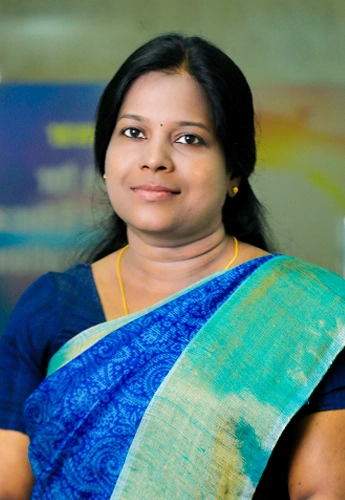
Dr.V.V.Teresa

B.E, M.E, Ph.D
D.O.J : 15.05.2013

Areas of Specialization

VLSI Design, Networking, Design Thinking

Dr.V.V.Teresa received her B.E degree in Electrical and Electronics Engineering from
Visvesvaraya Technological University (VTU), M.E degree in VLSI Design from Karpagam
University and Ph.D. in Information and Communication Engineering from Anna
University,Chennai. She has received AICTE funding for the Scheme -Promoting Interests,
Creativity and Ethics among Students (SPICES) in the year 2022. She has acted as Resource
person for a SERB- Three day National level workshop on Emerging Trends in Power
Electronics, Energy Storage and Renewable Technologies (PEESRT) for E-Transportation in
India, also invited as Resource person for ICSSR Sponsored “Two-day National webinar on
Effective Utilization of Renewable Energy for Smart Cities”. She has published more than 25
journals,3 book chapters and 3 patents. She has also organized several workshops,
seminars, interaction programmes on health, safety, literacy, entrepreneurship, legal rights
for women, Women empowerment and gender equity programs under Women’s Welfare
Committee and POSH Cell. She has coordinated the flagship events like Technovanza for two
consecutive years and Technovista a National level technical symposium under Sri Eshwar’s
Technical Club. Her Research area includes Low power VLSI, Image processing, Biomedical
Instrumentation. She is a professional body member of SSI, IETE, IAENG and IGEN.

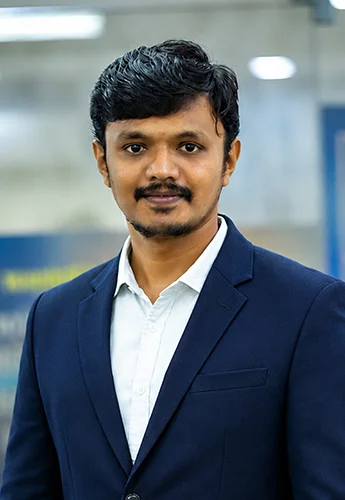
Mr.A.Vignesh

M.E., (Ph.D.)

Areas of Specialization

Artificial Intelligence, Natural Language Processing, Generative AI, Conversational Agents, Deep Learning, Embedded Systems & IoT

A. Vignesh is an Assistant Professor in the Department of ECE at Sri Eshwar College of Engineering, Coimbatore, specializing in Natural Language Processing and Conversational AI. He has published 3 SCI-indexed journal papers, 7 Scopus-indexed conference papers, and holds 8 Indian innovation patents. With over 5 years of experience in AI and embedded systems. He received the Best Research Paper Award at ICACCS 2024 and serves as Co-PI for a funded AI robotics project.

Mr.A.Kandeeban

BE(EEE) , ME (Applied Electronics)
D.O.J : 01.08.2025

Areas of Specialization

VLSI, Digital design and Verification, IP architecture

Kandeeban received his BE degree in EEE from Erode Sengunthar Engg college (Bharathiar University) and completed his ME degree in Applied Electronics at Coimbatore Institute of Technology (CIT) as a GATE qualified candidate. He holds a gold medal in both UG and PG. Subsequently he worked in Wipro as a Chip design engineer which included a stint in the US. Later he worked in Nvdia in a world-class IP design team followed by an 8 year stint in Intel as a Verification Architect. In these roles he was involved in creating high-quality IPs with zero bugs, and in leading junior engineers to first-pass success, as well as in publishing multiple papers within Intel.Currently he is the co-founder of a Coimbatore based startup specializing in IP Design and Verification.

Admission Enquiry 2025
=